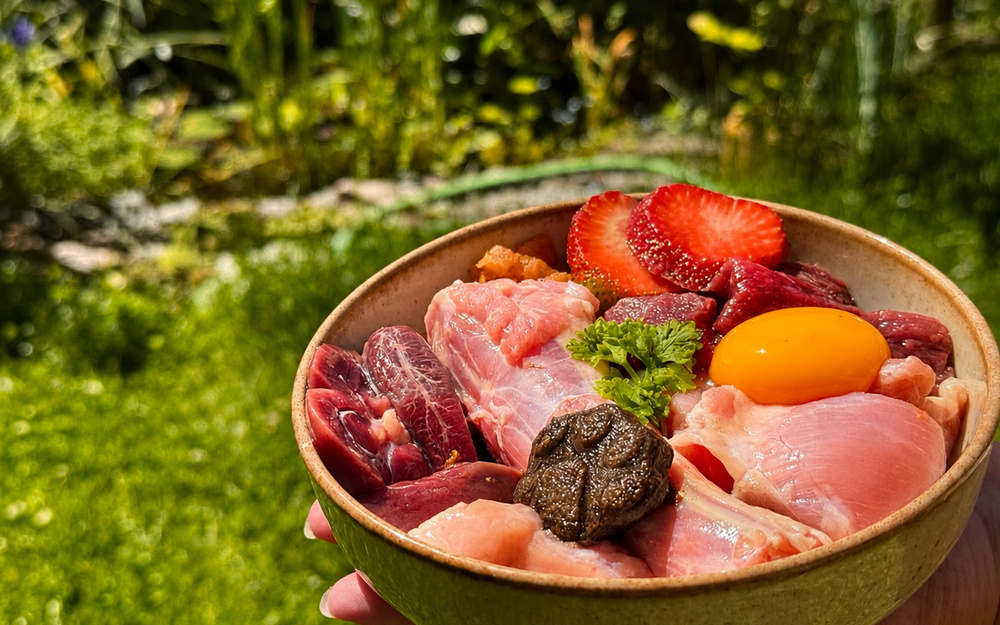
In home-prepared dog diets, the usual talking points are calcium, phosphorus, zinc, iodine or vitamin D. Manganese comes up less often, because it is not tied to one simple symptom and usually is not visible on a product label. That is a mistake. Research on home-prepared and raw diets shows that manganese can be one of the under-supplied nutrients.
Manganese is needed, among other things, for enzyme activity, metabolism and the proper formation of bone, cartilage and connective tissue. The requirement is not large, but if a diet relies mainly on meat, organs, eggs and bone, it is easy to fall short.
What the studies show
In a 2013 study by Stockman et al., 200 recipes for home-prepared maintenance diets for adult dogs were evaluated [1]. As many as 95% of the recipes had at least one nutrient below the NRC or AAFCO recommendations, and 83.5% had several deficiencies at once. Among the most commonly lacking minerals were zinc (below recommendations in 69% of recipes), copper (54%) and calcium (35%) — which shows how easy it is to miss trace minerals in a home-prepared diet.
An even stronger signal, this time about manganese directly, comes from a study of ready-made raw diets labelled as complete. Moravszki et al. analysed 33 commercial raw dog foods available on the market [2]. None met all of the FEDIAF mineral recommendations, and manganese was below the recommended level in 23 products, that is in 69.7% of the samples.
This does not mean that every home-prepared diet or every BARF diet is deficient. It means rather that without doing the math and without reliable ingredient data, it is very easy to overlook manganese.
Why a meat-based diet has trouble with it
Muscle meat usually contains very little manganese. In USDA FoodData Central data, values for raw meat are often trace amounts — for example, ground beef or chicken have around hundredths of a milligram per 100 g [8]. Eggs and dairy are not strong sources of manganese either. Organs do better, but they usually make up only part of a recipe, so on their own they do not solve the problem.
More manganese tends to be found in plant products, grains, seeds, some vegetables and algae. But dog diets do not always use large amounts of them, and some carry their own nutritional limits. That is why manganese often needs separate checking, rather than an assumption that it “will add up somehow”.
Requirements: how much manganese a dog needs
For adult dogs, a practical reference point is about 1.2–1.7 mg of manganese per 1000 kcal of diet, depending on the standard. NRC gives about 1.2 mg/1000 kcal [3], AAFCO corresponds to about 1.25 mg/1000 kcal [5], and FEDIAF 2025 for adult dogs gives 1.44–1.67 mg/1000 kcal, depending on the assumed energy intake [4].
In a diet generator it is best to look precisely at mg/1000 kcal, because the content per 100 g of a product alone does not tell you how much the dog actually gets in a daily portion.
Algae can help, but you cannot always count them
Seaweeds such as Ascophyllum nodosum are often used in BARF diets as a source of iodine. They can also contain manganese and other trace elements. The problem is that producers usually declare iodine, ash, protein or fat, but do not always state manganese.
This need not mean a producer error. EU feed-labelling rules require certain information to be declared, and naturally occurring trace elements do not always have to be shown as a separate figure [6]. FEDIAF, in its labelling code, also explains that a value in the additives section may mean the amount added to the formulation, not the total amount of a given element in the finished product [7].
For the owner and for the diet generator the effect is simple: the absence of manganese on a label does not mean the product contains none. It means it cannot be reliably counted.
Why it matters in practice
An example: if an alga contains 2.3 mg of manganese per 100 g, then 1 g of that alga contributes only 0.023 mg of manganese. That is little compared with a requirement calculated per 1000 kcal. On top of that, algae are dosed cautiously because of iodine, so you cannot simply increase the amount just to raise manganese.
That is why algae can be treated as a potential source of manganese, but only when the producer states a specific content, ideally in mg/kg or mg/100 g. Without that information it is safer to count them primarily as a source of iodine and to control manganese separately.
What to remember
Manganese is one of those nutrients that are not obvious at first glance. A diet can look natural, varied and “rich” and still have too little manganese. This applies especially to recipes based mainly on meat, organs, bone, eggs and small amounts of plant additions.
The safest approach is not to guess. In a home-prepared diet, manganese should be counted as deliberately as calcium, phosphorus, zinc or iodine. If a product is meant to be a source of manganese, you need a specific declaration from the producer or a reliable analysis of the raw material.
Sources
- Stockman, J., Fascetti, A. J., Kass, P. H., Larsen, J. A. (2013). Evaluation of recipes of home-prepared maintenance diets for dogs. Journal of the American Veterinary Medical Association, 242(11), 1500–1505. https://doi.org/10.2460/javma.242.11.1500
- Moravszki, L. et al. (2025). Assessment of mineral adequacy in preprepared raw dog foods labeled as complete. Scientific Reports, 15, 43447. https://doi.org/10.1038/s41598-025-27388-w
- National Research Council (2006). Nutrient Requirements of Dogs and Cats. The National Academies Press. https://doi.org/10.17226/10668
- FEDIAF (2025). Nutritional Guidelines for Complete and Complementary Pet Food for Cats and Dogs. https://europeanpetfood.org/wp-content/uploads/2025/09/FEDIAF-Nutritional-Guidelines_2025-ONLINE.pdf
- AAFCO. Dog Food Nutrient Profiles. https://www.aafco.org/wp-content/uploads/2023/01/Pet_Food_Report_2013_Annual-Appendix_B.pdf
- Regulation (EC) No 767/2009 on the placing on the market and use of feed. https://eur-lex.europa.eu/legal-content/EN/TXT/PDF/?uri=CELEX:02009R0767-20180101
- FEDIAF. Code of Good Labelling Practice for Pet Food. https://europeanpetfood.org/wp-content/uploads/2022/02/FEDIAF_labeling_code_2019_onlineOctober2019.pdf
- USDA FoodData Central. https://fdc.nal.usda.gov/food-search